Tuesday, August 31, 2021

Almost ready to get started...

Over the last five years or so I've regularly watched a YouTube channel of a guy who's bought a boat and embarked in a restoration.

On one hand it's been very entertaining as the guy in question makes good shows and does a better than most exposition of how to do stuff. While on the other hand it was interesting as he tended to make a lot of mistakes and was pretty forthright in letting you know about them.

What has been less enjoyable is the ongoing mission creep his restoration has gone through and as his popularity and income have increased the way it's become something of a consumerish cornucopia of installing the best and most expensive stuff he can find.

Which, I'll admit, is just fine where he's concerned and of course he has the right to spend as much money as he can afford doing his boat the way he wants to. But, for me, the problem is that they don't call youtubers "influencers" for nothing and it sends a message that the answer to most all issues where boats are concerned is more stuff more money. 

But, That's not how we roll here.

Since I've mentioned that I'm about to start building another self-steering gear I've received no shortage of emails telling me that folks are looking forward to some in-depth coverage of how I'm doing it. Then again, there's been quite a few folks telling me I'm an idiot because you need to spend over $5K to get a decent self-steering gear and that you get what you pay for and I expect you all know how much the "You get what you pay for" thing really gets up my nose.

I now have almost all of the materials needed for the Self-steering build and it looks like the total out-of-pocket expenses will not exceed $350-dollars. The good news is, at worst, it will be as good as an Auto-helm self-steering gear ($5250) and, more than likely, will work considerably better.

So, more on the self-steering ASAP...


Monday, August 23, 2021

It's almost boat show time...

This is about the time of year I perk up and pay attention to the various and sundry pre-boatshow press releases as there are usually some interesting bits of information on where boat design is going.

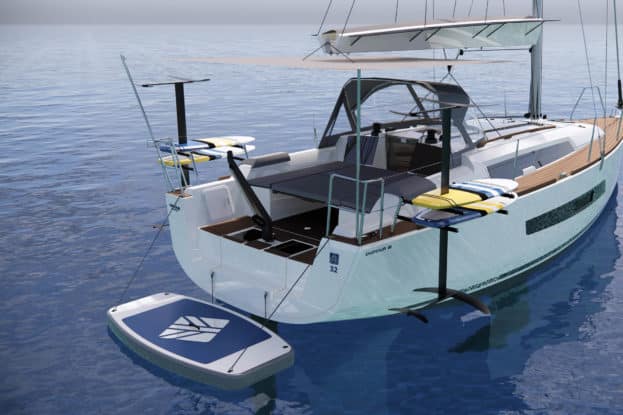
Take this new boat from Dufour...


It's the smallest boat in the Dufour line which in itself is interesting but the inflatable transom thingy certainly caught my attention.

Whatever it is it is most certainly a bit out of the box and most certainly bears looking into.

By the way, I'm well aware that a new Dufour, no matter how small, is not going to be a potential VolksCruiser until it's at least ten years older and on the used market. So, why the hell am I interested now?

Mostly mostly it's all about new ideas. Boat shows are full of interesting features and (dare I say it?) cunning plans. Some wind up being pretty useless or dumb but a few are real improvements and a minute number become real game changers.

Offhand, I don't think the inflatable transom thingy is a game changer but it is an out-of-the-box idea that could easily be reverse engineered, DIY'd, and retrofitted to a VolksCruiserish boat. 

Which for me makes boat shows and the press releases leading up to them a wonderful source of ready to be purloined ideas that just might make a big difference in the performance or livability of your old classic plastic design.

Need I say more?


Saturday, August 7, 2021

Why I'm building the B&B self-steering design...

The idea of self-steering is, for all practical purposes, a pretty simple concept and most all self-steering systems reflect that. Or at least the good ones do.

The problem with the idea of home building a self-steering gear, for most people at least, is that they tend to have a certain amount of mechanical parts which tend to be just a little bit fiddly to construct and sourcing various fiddly parts is more than just a little problematic.

Some time ago, I designed a self-steering gear that, with the exception of the auxiliary rudder and trim tab, consisted of off-the-shelf items made by a single company which made sourcing the "fiddly" bits simple, cheap, and required zero machining or welding. The downside of the design was that as soon as I started to sell plans for the self-steering the company that made the fiddly bits was absorbed by another company who's first decision was to discontinue sales of the parts in my design. Bummer.

Since then, I've pretty much advised folks interested in building their own self-steering gear to do what I do and just build a clone of the Auto-Helm gear as it is dead simple, has a minimum of "fiddly" bits, fairly cheap to build and works very well on just about any boat.

A little over a year ago one of my favorite sources of dinghy plans, B&B, mentioned that they were currently working on a DIY self-steering gear and, looking at the available information at the time, I said to myself that it's pretty much a clone of the Auto-Helm but noticed one big difference...

The B&B rudder was not mounted to the transom but to a "rudder post" that allowed the rudder to kick up in the event of hitting something. Better yet, the rudder post also lets you raise the rudder out of the water if you needed to motor in reverse (an issue for auxiliary rudder systems) or just stow the self-steering gear upside down above the transom when not needed. A small but truly brilliant improvement.

Now, I'll admit, my first thought was to simply build my normal Auto-Helm clone and just purloin the rudder post idea but, since the plans were only $50 bucks and in my view the rudder post idea was easily worth more than that, I decided to just buy the plans.

Now that I've actually received the plans I'm glad I did because they are excellent as well as incredibly detailed and pretty much tyro proof. Obviously B&B has sold tons of dinghy plans and in the process they've learned  how to design plans that are easy to build. The plans are actually more than enough to build the gear but they also include a "Builders Guide" which goes that little bit further to answer any possible questions one might have in the how or why things go together.

At the moment they have three sizes of Windvane self-steering gears, the Rover, Nomad, and Wayfarer which are size appropriate to fit most any boat you might have. In our case we're going with the Wayfarer...

So, that's the self-steering I'm about to start building and hope to get into it in the next week or so, "H" season willing. There are three potential storms heading our way as I write this.


Friday, August 6, 2021

Almost time to get to doing...

A quick update on the self-steering project. I now have all the various bits on island with the excepting of the needful wood which is just a dinghy row away.

So, hopefully, in the next few days I'll be getting the wood for the project along with a few sheets of plywood for a new dinghy build and be able to sort out the actual cost.

More about the actual self-steering design tomorrow...

Monday, July 26, 2021

Getting ready to build a new self-steering gear...

So, yeah, about that new self-steering gear...

Right now I'm in the process of getting all the bits together to assemble a kit to build the it and the various pieces not readily available on a tropical island paradise are, mostly, currently winging their way to my PO box.

Putting together a "kit" before starting just about any boat project in my opinion is a must because when I do a project I like to do it full on and as non-stop as possible. Having all the needful bits in hand means you don't have to waste time running momentum killing errands.

Another advantage of putting together a kit for your project is that it forces you to get familiar with how it all goes together before you actually get to doing the actual work. Building projects in your head is a great way to see where problems may crop up and sort out workarounds and improvements to the mix. For instance, one part of the design bothered me because I don't enjoy tapping stainless steel rod and while going over the plans again and again while looking at suppliers catalogs I had a serendipitous moment where I came across an easy replacement method to get way from tapping rod which also makes the windvane simpler, offers easier adjustment, and saves some money in the process.

Lastly, done right, putting a kit together tends to save a significant amount of money while allowing a better quality of components. Just buying the various fasteners for the project off island saves me close to a couple hundred dollars compared to the silly pricing of stainless screws and bolts.right now I'm looking at a budget of around $350 for the complete self-steering gear but, when the gear is complete I'll be publishing all the various costs so we'll see how my current estimate holds up once the actual gear is complete.

Next up on the subject is why a chose this particular self-steering gear to build...

Saturday, July 17, 2021

on creative frugality and some coming changes...

There's a cooking channel that I really enjoy by Joshua Weissman and one his features are recipes where he does some established dish adding "But Better" or "But Cheaper" to the mix. It's entertaining and I've yet to come across an episode of his that did not have me wanting to get in the kitchen and get to doing.

For example...


Which has exactly "what the hell to do with VolkCruisers and frugal cruising?" you might ask.

What most people don't get is the whole idea here at VolksCruiser is to make the cruising experience more accessible to those with less disposable income or savings to do it with. I too often get emails to the site saying it's easy to sail and cruise cheap and all you have to do is to simply lower your standards and get into dirtbag camping mode which, to be honest, I find all sorts of insulting.

The fact is there's really very few reasons not to be comfortable cruising these days or, for that matter, thriving on a sustainable budget as opposed to being tarred with the dirtbag moniker as not quite hip or affluent enough to play with the "cool" kids.

Which brings us back to the whole "But Cheaper" and "But Better" additions that Joshua Weissman brought to my attention and morphed into a better way to think about VolksCruisers and frugal cruising...

It's all about doing it better and cheaper!

With an emphasis on doing it better.

Maybe a whole lot better.

So, with a nod to Mr Weissman, I'll be adding a series of articles to the mix of a "But Better" or "But Cheaper" nature and we'll show you examples of how not to just survive but thrive as we get into some serious creative frugality territory.

Since I'm just about to build a new self-steering gear I'll get started with how to put together a better windvane steering system but cheaper.

More soon come...

Support BoatBits

Monday, July 5, 2021

regarding a very long voyage in a pretty small boat...

I read recently how Keith Leitzke has returned from another cruise to nowhere in particular and it got me thinking about a few things...

The first being how that Bill Lapworth's CAL 20 is still a great minimal cruising design in spite of the fact that it was never really designed to be one.

While I'm sure the Cal 20 would not be everyone's choice for a long sea voyage apparently Keith Leitzke thought it was just the thing for a four month or longer blue water voyage.

The fact that the Cal  20 has more than proven its blue water bona-fides with numerous trans-pacific voyages to its credit just goes to show that seaworthiness is not dependent on cost or size.

Of course, doing extreme blue water voyages in small boats means that one has to get creative to the Nth degree where space and loading is concerned. Seriously, just how do you store four months or more of provisions, water, and other needful gear?

Just thinking about how to store 120 gallons of water on a Cal 20, for starters, kinda makes my brain hurt! Throw in the provisions of even the most stoic menu for four+ months and you're talking about some genius creative use of space...

Well that or getting into TARDIS territory.

The important thing to keep in mind is that, obviously, it's been done so it's possible and knowing something is possible means all you have to do is figure it out because impossible is no longer an option.

Just sayin'

Support BoatBits

Monday, June 28, 2021

A few quick thoughts...

A YouTube channel I have a love/hate relationship with has a Bluetooth enabled toilet and I just can't quite get my head around why one might actually need such a thing. 

As it happens, I do have some Bluetooth headphones which I purchased because I wanted to be able to listen to music while working on boat projects but never use them because the signal drops out all the time and that really gets up my nose where listening to music is concerned.

But still, one wonders what sort of advantage a Bluetooth toilet has and WTF they actually cost.

That said, however misguided having to be connected to one's toilet via Bluetooth might be, it is preferable to some of the sailing channels which are starting to look a lot like infomercials instead of videos about cruising as one I recently viewed mentions the name of a certain purveyor of sewing machines, fabrics, and assorted notions so many times that the only words that comes to mind is "Set it and forget it!".

But wait, there's more! 

Well actually there isn't but the whole Ronco style of over-commercialization and  pandering is so far removed from the whole VolksCruiserish "Just find a good boat, fix it up, and sail off into the sunset on a sustainable budget" vibe most of the cruisers I admire adopt just depresses me.


Monday, June 14, 2021

The upside of DIY...

The other day a reader dropped me a line where the subject of DIY came up and he pointed out that, unlike me, he could afford to hire folks to do work for him and if you had to DIY you might want to consider something other than yachting as a lifestyle decision...

Not the first time I've heard that opinion and, I expect, most folks of the VolkCruiserish ilk will hear it as well.

What the reader in question doesn't quite get is that the advantages of doing work on your boat and its systems yourself has a great number of advantages which improve the sailing and cruising experience and the fact that it also allows you to save money in the process is just an added perk which is no bad thing.

Sadly, too many of the marine trades are not just over-priced but also woefully short on the needed skills that they charge you for. I've seen too many projects and repairs done by various contractors that not only did not fix the needful repairs but wound up creating more damage and problems that would be left for someone else to fix.  

An advantages of doing your own work is that you actually know how things are put together on your boat and that gives you the skill set to fix it when or if it needs to be sorted out. Sure there's a learning curve but it's a fairly easy one as almost all boat related work is just minimum wage level stuff mixed with common sense.

No rocket science involved.

Being able to handle maintenance and repairs is both empowering and adds greatly to the overall safety of the boat and its crew. Which, from where I sit, are the two most important reasons to get your DIY groove on.

Lastly, doing work that fixes things is mostly enjoyable and satisfying. Of course, not everyone enjoys all boat work and I'll be the first to admit I really do not like working on internal combustion engines as it's a UGH job as far as I'm concerned, Still, in spite of the UGH nature of working on engines, I find it especially satisfying when I'm able to fix one.

I'll also add that saving money is a game I really enjoy and the perks of doing my own work adds up to a considerable chunk of change in the process which makes DIY that much more enjoyable. Then again, some folks don't mind paying $4.99 for a  twenty-five cent machine screw and take pride in throwing around how much they paid for stuff as a badge of honor. Not sure where you stand on such things but the whole Boat Buck mentality seems somewhat questionable at best.

Oh yeah, on the whole yacht thing... I don't own a yacht, don't want to own a yacht, and cringe whenever I hear a boat described as a yacht or a person sailing it a yachtsman. So I'm not exactly the sort of person who would ever consider yachting as a lifestyle.


Saturday, June 5, 2021

A blast from the past on junk rig...

A Freedom cat ketch adapted to junk rig

 I wrote this back in 2008 on Boat Bits but it seems to have held up for the most part...

I suppose the minute you say lug rig that everyone assumes you are talking about the "Junk" rig which is certainly a type of lug rig but somewhat outside the mainstream lugs...so we might just get the whole junk rig thing out of the way and as good as any place to start.

Colvin...Hasler...Van Loan..Mcleod important names for Lug nuts as all were big proponents of the junk rig in the early days and for a host of very good reasons you would be safe to follow their lead...The Junk rig certainly makes a lot of sense for a lot of people who sail.

The big thing about the junk rig is of course it is a docile rig... Stress free if you will...Its an easy rig to sail (but a very easy rig to sail badly and it is important to know the difference between the two) and there is a rather steep learning curve if you actually want to get the performance possible with the rig. Make no mistake this is not a Bermudan rig and if you try to sail it like one you will find that it will behave just like all of its detractors say it will...BADLY.

Its also a cheap rig and DIY safe on all levels so building it from mast to sails is well within even the most ham fisted tyros reach! Sounds perfect for folks like me...and did I mention CHEAP?

Of course you hear a lot of bad stuff about junk rigs and almost all of it from people who have never sailed a junk rig and many who have never even seen a junk rig sailing...This is not an unimportant fact when you consider that 95% of the information you receive via word of mouth on things junk is in fact pretty bogus. Luckily we have access to a lot of excellent information from those who really know what they speak of...

Which brings us back to the names Colvin, Hasler, Mcleod, and Van Loan who all were nice enough to sit down and write excellent books on the subject so we would not have to figure it out all by ourselves.

Thomas Colvin has written a slew of books on sailing, cruising and building boats and anything he says you can pretty much take to the bank. Not a man who feels the need to follow the herd or bend to market pressure he is very much the real deal and unlike so many Naval Architects has actually built boats, lived aboard and cruised which in my book puts him way at the front of the herd and when he says something you can take it for granted that it's based on real experience. Sadly Tom Colvin is no longer with us and a lot of his books are now out of print but I believe are available used if you put in the effort to find them. A visit to Abe's books might be in order to chase down a copy of "Sailmaking: Making Chinese and other sails : Sailing Chinese Junks and Junk-rigged vessels" .

McLeod / Hasler wrote the most excellent "Practical Junk Rig" which is a thing of beauty almost a Coffee Table book on the subject and again written by a couple of guys who walk the talk and a tome that is needful to anyone considering or sailing the junk rig.

My favorite though is the very simple, Tract like and easily understood "The Chinese Sailing Rig - Design and Build Your Own Junk Rig" by Eric Van Loan which is short and very much to the point. Just what you need if you have a CAL 28 ( or whatever) and decide you want to design and build a junk rig for it that will WORK!

While the Van Loan book is my favorite (I do love simple!) and would be my choice if I were limited to one source, to be honest if you are going to do the Junk rig thing right you really need all three as they together pretty much contain all available information in book form on the rig and it is all needful information.

I should add at this point that there is the excellent Junk Rig Association which which is the best source of cutting edge development in what is trending in junk rig development.

While not really about the junk rig Annie Hills book "Voyaging on a Small Income" just might be the best book to read and get you started on the Junk express as it has a lot of Junk content and gives you a very good view of what sailing with a Junk Rig is all about...Annie Hill shows just what can be done with a simple Benford designed plywood boat called Badger and a junk rig on a budget. If you ever need a good example to throw in the face of someone who is going on about junk rigs being not a viable option just bring out the Badger card ...Works every time!