Showing posts with label Rigs. Show all posts

Saturday, March 18, 2023

Some thoughts on the CAL 34...

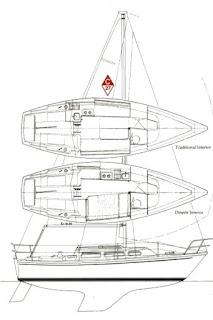
It's come to my attention that there are several CAL 34s going cheap (as in less than $3K). This got me thinking about how I'd go about VolkCruiserizing them today knowing what I know now after living aboard and sailing "So It Goes" for ages.

For starters, there's a CAL 34 going for $1k which is floating right side up, has a mast, and an engine that does not work. I expect there are a bunch of other issues but at less than the cost of the lead in the keel $1,000 would still be a lot of boat for the money.

My first thought would be to get rid of the mast and rig since I'm sure that the rig is way past its sell-by date. The mast could be salvaged and I could sell it for $500 or so which is close to what I could build a new mast in terms of materials. Since I'm sure I'd also have to replace the dreaded I-beam, it would also be a great time to beef up the compression post to support a serious tabernacle arrangement if keeping the boat as a sloop or change the location of the step in aid of a junk or lug rig.

Then there's the non-functioning motor which I'd replace with an Atom Voyager inspired outboard installation with either a 6HP gas or electric outboard which is really all one requires to move the boat when needful. While I'm at it, I'd seriously consider moving the rudder back to the transom which would improve the balance and make incorporating a simple self-steering trim tab both cheap and easy.

As far as the interior goes, the Lapworth design works just fine and while I'm sure it would need some work and sprucing up, it wouldn't be difficult or expensive.

The rest just comes down to cosmetics.

Do the work yourself, use affordably sourced materials, avoid mission creep, and you'll have a pretty awesome boat for $7.5K or less.

I'll go into a bit more detail in the next post...

Saturday, March 11, 2023

an awesome shoal draft design...

Offhand, I really do think that real (3' or under) shoal draft makes all kinds of sense for anyone looking for a VolksCruiser. Having a boat that can anchor in places others fear to tread or navigate, that's also beachable if needed, and ocean capable is really a no-brainer.

For instance, take a look at the Beachcomer 25...

Drawing only 1' 3" with the board up this Walter Scott design is what shoal draft is all about. As it happens Scott also designed the Irwin 10/4 which is my favorite Irwin and another possible VolksCruiser candidate that is well worth checking out.

The Beachcomer has what I like to think of as a civilized interior layout as it provides everything needful in a manner that is both comfortable and practical. 

The cat ketch rig is a great rig with little to go wrong and much to recommend it. I'm still astonished that we we're still sailing Bermudan sloops when there are so many clearly superior rigs we could be using.

The downside of a 25-foot boat is mostly about stuff or, in truth, the inability to carry a lot of stuff you really don't need. That being the case, it's a great design for someone of a minimalist bent but not so much for those who don't quite understand the advantage of less.

There's quite a bit more information over at Catketch.com website for the Beachomer 25 you might want to peruse.


Friday, February 24, 2023

OK, I'll admit it...

I've got a bad case of bowsprit envy! While perusing the Craigslist I saw a fifty foot Bugeye going for $16.5K.

Now, I'll be the first to acknowledge that I can't really afford to cruise on a fifty-foot vessel no matter how much it's a work of art and sexy as hell. Adding in the fact that the sparred length is a whopping 65' and that's just going to make haul-outs, marina visits, and incidental cruising expenses a lot more than I can afford.

But, still, the prod on "So It Goes" at two feet compared the the magnificent bowsprit on the Bugeye makes me feel just that little bit embarrassed.


So it goes...

Tuesday, January 17, 2023

an almost cunning plan...

There's a J-29 up in the frozen north that I've been thinking about quite a bit. For those unacquainted with the design it looks something like this...

It, like most of it's J-Boat brethren, is a boat designed and built to be competitive so you may be wondering why the hell am I looking at it?

Well, you might say, I have a sorta/kinda cunning plan for a boat of this ilk.

For starters there's not much of an interior so it would be very easy to do a new performance cruising interior and as long as we're installing a neat little galley we might take the opportunity to do a new mast step while we're at it.

A new VolksCruiserish rig spelled junk or lug would make for a neat testbed and as there are quite a few J-29s about it owned by folks who'd enjoy sailing against a J-29 with a different (some might call it freakish) rig it would be an awesome educational endeavor and I'd enjoy it.

As the boat in question is selling for not very much I'd expect to be able to the needful mods and suchlike to keep the finished boat a kiss less than $10.5K.

The only issue that keeps me from jumping on a plane cash in hand to get is the fact that the J-29 has almost six feet of draft and that's not going to work for my cruising plans.

So it does go.

That said if draft is not a deal breaker for you the J-29 is a pretty great candidate for a performance VolksCruiser and you might want to keep an eye out for a good deal on one.


Friday, August 26, 2022

a little heresy...

I've always liked the gaff rig because it's a stout spar that does not require a lot of tension to stand. There's a lot to be said for that.

While I don't think that Tom Colvin's junk rigs were fully evolved they did make a whole lot of sense.Take his Gazelle for instance.

Minimal stays with the ability to carry a jib makes all kinds of sense to me. The masts are lighter and less expensive than free-standing masts. Mast placement tends to be more normal in the sense that they are less radical where the interior is concerned which is no bad thing when dealing with a classic plastic boat. The fact that a jib is a great aid to balancing the sail plan and helps with windward ability is an added bonus. The Colvin rig makes a lot of sense.

Then again, it would make even more sense if it was brought into the current century.

Yep, I'm well aware that most junk rig aficionados tend to be foresail and standing rig phobic but a well designed junk or lug cutter would make all kinds of sense where a bombproof, powerful, and inexpensive rig is what you want.

With the current available tech it would be easy to build a light spar in plywood (see Reuel Parker's) and since textile rigging has become an available affordable alternative it's within the reach of anyone. Take a little extra effort and serve the rigging and you'll have a rig that will last into the next century.

Might be a bit of heretical thinking you should think about.


Wednesday, August 24, 2022

a couple of thoughts on spar building...

When considering changing to a rig like the balanced lug or junk, the first issue is that it requires moving the location of the mast. Finding the location is easy, but it can play hell with the interior. Free-standing masts, while not being as tall as the Bermuda rig, are larger in terms of diameter and a 10-inch diameter spar will create bloody havoc with the accommodation.

Which may be an excellent reason to keep your Bermuda rig if it’s still standing with decent rigging and sails. 

In the future, I’ll be doing an outline on how to locate the mast, build the mast, and otherwise get you through the new rig process for a more-or-less traditional junk or balanced lug rig. 

Here are a couple of things to mull over.

Is the new mast location going to work with the current interior arrangement? If not, peruse accommodations that would work with minimal fuss.

Do you have a place to build a mast?

The current mast on “So It Goes” should have taken me a week to build. The reality was it took a lot longer, and it was a nightmare to build. I was building in a parking lot with zero protection from the elements. I had to stop whenever it rained or seemed like it would rain, which was just about every day. The landlord of the property made the task worse. He really didn’t want me building there, which fostered a very negative workspace. My spar bench was “bumped” regularly in the parking lot, causing me to re-level the bench/molds before getting to the actual work.

I really should have found a better place to build, as it would have saved me both money, aggravation, and with a better built mast to boot.


Support BoatBits

Monday, August 22, 2022

Some required reading...

The popularity of the Bermuda rig has caused a general lack of knowledge on most other rigs and how to rig them. Luckily for us a few books are all you need to sort out that problem.

Phil Bolger's "103 Sailing Rigs" talks a lot about various rigs and their variations in a common sense manner and well worth reading. It certainly opened my eyes where rigs are concerned.

For me Derek Van Loan's "The Chinese Sailing Rig" is the best book (Booklet?) going for converting a Bermudan rigged sailboat into a Junk rig. It's simple, clear, and it's brevity make for an easy to follow "cookbook" that makes conversion dead simple. Detractors of the book will argue that it is dated and does not include current thinking in sail design and construction but that is easily found on the JRA website but the basic conversion info is exactly what you need for a successful conversion.


Hasler and McLeod's "Practical Junk Rig" is an excellent tome on the junk rig and there is a lot of needful information. That said, it's a hard read (for me at least) and you really have to dig for that needful content. That said, it is a book you want but for starters the Van Loan book is the way to go to get started. 

It's also expensive (the Kindle version is $47.49 which is akin to piracy) so you'll want to keep an eye out for a used copy.


John Leather's "Spritsails & Lugsails" really needs to be on any Lug Nut's bookshelf. Sadly, most folk these days look at Sprits and Lugs as some sort of dinghy sail only and miss the fact entirely that they are powerful rigs that would make a lot of sense for boats in the VolksCruiser size range.


"The Gaff Rig Handbook" by John Leather is the bible for devotees of the Gaff rig and well worth a space on your book shelf. The gaff rig has a lot going for it and, mostly, suffers from the fact that most Gaff rig folks are unwilling to bring an excellent rig into the current century.
 

More on the practical side "Hand, Reef, and Steer" by Tom Cunliffe is the one book I'd choose if I was limited to a single gaff rig boat. Cunliffe is always an enjoyable read and has walked the talk more than most.


"The Rigger's Apprentice" by the late Brion Toss is a book that changed my life in the way I look at boat systems. It contains everything you need to know about sailboat rigging and makes all the rigging jobs you might encounter doable.

All of these books went a long way to color my thinking of what sailing rigs should be. Sure, I have a few issues with a few bits of the various author's opinions but in whole they're mostly spot on and needful if you're thinking of adapting a Bermudan rig to junk, lug, or gaff.


Sunday, August 14, 2022

some lug nut thoughts...

First of all If you have a boat with a working Bermuda rig keep in mind that it seldom makes sense to do a new rig (Lug, Junk,Crab Claw, or whatever). Remember the "Don't fix it if it's not broken" rule.

Now, if on the other hand, the CAL 29 you're thinking of getting has no sails, the rigging is shot, and your mast has seen better days a change to a simpler rig just might make a lot of sense.

With me so far?

OK, here's what you need to know about lug rigs...

For starters there are three main types of lug sails which are the Dipping lug, Standing lug, and the Balanced lug. While all three are excellent rigs I'm of the considered opinion that the Balanced lug makes the most sense for a cruising boat.


So, what do I like about this Bolger Balanced lug rig?

  1. It's simple. All you need is a mast, sail, a halyard, a sheet, and a few blocks. The mast is free standing and requires no rigging or associated hardware.
  2. Being a square sail the center of effort is lower than in a Bermuda rig which results in less heeling forces.
  3. It's a powerful sail for not a lot of money.
  4. The balanced lug rig is self-vanging which makes for docile handling.

What's not to like? 

Well for starters, if you want an affordable free standing mast and the associated boom/yard you'll have to build it yourself. That said, the cost of said mast and spars is a lot less than an aluminum stick and associated wire/hardware needed for the Bermuda rig. Better yet the learning curve for mast building is not so difficult and a rather enjoyable pursuit. Still it is a rather daunting project for a lot of folks.

The Balanced lug rig, while being fairly evolved, could certainly use a bit of improvement to bring it into the current century. Most of which is already in use readily available with a bit of thought and research.

Over the years my thinking about sailing across oceans with a cat rigged boat have evolved somewhat as has my thought process in terms of building free standing spars but we'll get into that in some depth next time.

Monday, August 8, 2022

A few thoughts on VolksCruiserish rigs...

Just about all of the boats I cover on VolksCruiser have the same rig and it's a problematic affair.

For starters, I actually like the Bermuda rig as it's highly developed and if you're going to race it's pretty much the only one you can use. That said, if I were designing a cruising boat it would just about be the last rig I'd choose.

So, what's wrong with the Bermuda rig?

Let me count the ways...

  1. For maximum performance the Bermuda rig requires a sail inventory that takes up more space than your average cruising boat has room for.
  2. While highly developed, the rig is also highly monetized which makes it very expensive.
  3. Any rig 100% dependent on rigging to stand up has lots of potential failure points any of which can result in a mast-loss clusterfuck.
  4. Sailing a Bermuda rig is labor intensive. Which is OK when you're racing, not so much when you're crossing an ocean.
  5. While the Bermuda rig is highly developed, it was a poor choice to development over more powerful and efficient rigs. If you have a chance you'll want to read any of C. A. Marchaj's books on the subject as they'll rock your world.

So, if the Bermuda rig has problems what's better? Well according to the wind tunnel testing by C. A. Marchaj just about every rig out there is better than the Bermuda rig. So take your pick.

In my case; I'm still partial to the various lugs and junk rigs. Then again, I'm not a purist "Old Gaffer" sort of fellow and see no issues in taking a lot of that Bermuda rig science and applying it towards making a lug rig perform better, less prone to failure, and easier to use.

But more on that subject next time...

Sunday, May 22, 2022

a good example of less being more...

 Here's an interesting rig on Reuel Parker's Terrapin 30.

What really appeals to me is not so much what it has but what it doesn't have.

For starters, it's a three stay rig made possible by a low center of effort. A low powerful rig requires less ballast which is no bad thing as it reduces heel.

A rig like this requires very little in the way of expensive hardware. The fact that a simple rig is also going to be a lot cheaper to build and maintain is just icing on the cake.

The wood tabernacled mast is owner buildable and serviceable plus, in the days of $500 mast stepping, the tabernacle will easily pay for itself from the get-go.

If I found myself with a CAL 29 or reasonable facsimile without a rig or a rig needing serious investment/repair I'd seriously consider doing a similar rig. Sure, you'll scandalize some folks in the process but the rig will work just fine and there's not much prettier than a gaff rig sailing into the sunset.


Monday, April 18, 2022

in search of a simple rig...

Sailboat rigs are a problematic conundrum where VolksCruisers are concerned. For starters, most rigs on classic plastic boats have rigs that have evolved from designs for racing. They’re over-complicated, prone to failure, and expensive, which is not the sort of rig you want when voyaging on a budget.

Adapting rigs to be simpler, more affordable, and less expensive is no simple task, which may cause an extended stay in a room with padded walls. While it can be done, the easier route is where you build a new rig.

While there are many varied rigs to consider, I’ll just mention four.

The various permutations of the lug rig are a good place to start. In particular, I’ll opine that the balanced lug rig is a great voyaging rig. It’s as simple as you can get and uses hardly any hardware. On our Bolger Jessie Cooper, it only needed two lines (halyard and sheet), required no winches and only one block. The sail was powerful, easily pushing Loose Moose above hull speed. Better yet, the entire rig was repairable with materials available anywhere.

Then there’s the junk rig, which is really just a balanced lug with a lot of battens and cordage added to the equation. It’s not as powerful as the balanced lug, but it’s easier to reef, which is the principal attraction for most of the junk aficionados I know.

The gaff rig is more complicated than the various lug rigs, but it’s a simple and powerful low stress rig based on old-tech that has a lot of advantages.

Last, I’ll throw the Simplicity rig into the hat. It’s simple, powerful, and even looks like what people actually expect a modern sailboat rig to look like. It’s what we have on “So It Goes” and it makes sense in the world of evolved rig designs of the simple sort..


The big issue with simple voyaging rigs is that they seldom exist on boats that are for sale. If you want one, you’ll have to build it yourself.

Of course, if you’re like me and cheap, you’ll find the idea of either hassling with the sale of the existing rig or throwing the rig away to be counter-productive to your mental health. Which is why, for me at least, the perfect boat to buy is one unencumbered by rig and rigging.

The thing is, any of the aforementioned rigs are easy to build, won’t cost a lot of money compared to “modern” mast/sails, and they are easier to maintain in the long haul. They’re also less prone to failure, which makes all the difference in the world.

Saturday, April 16, 2022

A quick thought on performance...

Talking about performance where cruising boats are concerned is somewhat problematic at best. Most folks' first thought when the subject of performance is breached, immediately think in terms of speed and going fast. However, speed is not the only way to think of performance.

Obviously, a cruising boat needs to be able to get from one place to another in a timely manner. While I certainly second that it doesn't require getting to one's destination at full tilt boogie speeds. 

Full tilt boogie equals stuff breaking.

So, where does performance come in?

A well designed hull is easy to push through the water and does not require a a big rig to achieve hull speed.

A smaller rig is less expensive, produces less wear and tear on the boat, and is less likely to fail. Which, from where I'm sitting, is a very good thing.

More on VolksCruiserish rigs up next...


Thursday, January 20, 2022

and in the best rig for a VolkCruiser department...

Yann Quenet showing off a balanced lug roller reefing set up.

Monday, December 6, 2021

Boats with problems...

Boats in the VolksCruiser budget zone are going to have problems or issues you’ll have to deal with. Just accept it as part of the territory, which is not always problematic. A sailboat with the right issues could very well be to your advantage.


There’s a Catalina 27 with a broken mast that would make an excellent candidate for a junk rig conversion I’ve had my eye on. The current asking price is $2K. Finding a used mast and rigging will raise the cost more than you’ll want to spend. I’ll also point out that without a working rig you can make a lower offer that the seller should agree to.

Building a junk rig (spar, sail, and running rigging) is not that difficult or expensive. The cost is less than a new mast. So it makes sense to go with the junk rig rather than replace the original rig. The boat comes with a full set of C27 sails that should be easy to sell and cover some of the cost of the junk rig.

Adding the junk rig to the mix will make the C27 a better cruising boat and open up some space below by not having to store unused sails. A junk rig will also increase the value more than the cost of the new rig.

Which, I think most of you’ll agree, is a win/win situation.

More on problems that may actually be advantages in disguise soonish...


Saturday, June 5, 2021

A blast from the past on junk rig...

A Freedom cat ketch adapted to junk rig

 I wrote this back in 2008 on Boat Bits but it seems to have held up for the most part...

I suppose the minute you say lug rig that everyone assumes you are talking about the "Junk" rig which is certainly a type of lug rig but somewhat outside the mainstream lugs...so we might just get the whole junk rig thing out of the way and as good as any place to start.

Colvin...Hasler...Van Loan..Mcleod important names for Lug nuts as all were big proponents of the junk rig in the early days and for a host of very good reasons you would be safe to follow their lead...The Junk rig certainly makes a lot of sense for a lot of people who sail.

The big thing about the junk rig is of course it is a docile rig... Stress free if you will...Its an easy rig to sail (but a very easy rig to sail badly and it is important to know the difference between the two) and there is a rather steep learning curve if you actually want to get the performance possible with the rig. Make no mistake this is not a Bermudan rig and if you try to sail it like one you will find that it will behave just like all of its detractors say it will...BADLY.

Its also a cheap rig and DIY safe on all levels so building it from mast to sails is well within even the most ham fisted tyros reach! Sounds perfect for folks like me...and did I mention CHEAP?

Of course you hear a lot of bad stuff about junk rigs and almost all of it from people who have never sailed a junk rig and many who have never even seen a junk rig sailing...This is not an unimportant fact when you consider that 95% of the information you receive via word of mouth on things junk is in fact pretty bogus. Luckily we have access to a lot of excellent information from those who really know what they speak of...

Which brings us back to the names Colvin, Hasler, Mcleod, and Van Loan who all were nice enough to sit down and write excellent books on the subject so we would not have to figure it out all by ourselves.

Thomas Colvin has written a slew of books on sailing, cruising and building boats and anything he says you can pretty much take to the bank. Not a man who feels the need to follow the herd or bend to market pressure he is very much the real deal and unlike so many Naval Architects has actually built boats, lived aboard and cruised which in my book puts him way at the front of the herd and when he says something you can take it for granted that it's based on real experience. Sadly Tom Colvin is no longer with us and a lot of his books are now out of print but I believe are available used if you put in the effort to find them. A visit to Abe's books might be in order to chase down a copy of "Sailmaking: Making Chinese and other sails : Sailing Chinese Junks and Junk-rigged vessels" .

McLeod / Hasler wrote the most excellent "Practical Junk Rig" which is a thing of beauty almost a Coffee Table book on the subject and again written by a couple of guys who walk the talk and a tome that is needful to anyone considering or sailing the junk rig.

My favorite though is the very simple, Tract like and easily understood "The Chinese Sailing Rig - Design and Build Your Own Junk Rig" by Eric Van Loan which is short and very much to the point. Just what you need if you have a CAL 28 ( or whatever) and decide you want to design and build a junk rig for it that will WORK!

While the Van Loan book is my favorite (I do love simple!) and would be my choice if I were limited to one source, to be honest if you are going to do the Junk rig thing right you really need all three as they together pretty much contain all available information in book form on the rig and it is all needful information.

I should add at this point that there is the excellent Junk Rig Association which which is the best source of cutting edge development in what is trending in junk rig development.

While not really about the junk rig Annie Hills book "Voyaging on a Small Income" just might be the best book to read and get you started on the Junk express as it has a lot of Junk content and gives you a very good view of what sailing with a Junk Rig is all about...Annie Hill shows just what can be done with a simple Benford designed plywood boat called Badger and a junk rig on a budget. If you ever need a good example to throw in the face of someone who is going on about junk rigs being not a viable option just bring out the Badger card ...Works every time!

Monday, May 31, 2021

one sail to rule them all...

There are a lot of fans of the junk rig who, being fans and all are true believers when it comes to their preference of rigs. The junk rig is superior to all other rigs or in common parlance the junk rig is "the shit".

Me? Well I certainly think that the junk rig is a good rig but, where sailing is concerned, there really is no one rig that is the best in the general scheme of things. There are lots of rigs and they all have their strengths and weaknesses and while one rig or another might be "best" in a given situation for someone in particular, I hesitate to call any rig the best in the general sense.

But, as it happens, in the particular situation where someone is considering a rig for frugal cruising on a small (let's say thirty-feet or under) sailboat the junk does have a lot to recommend it.

  1. It's an inexpensive rig if done right.
  2. You don't need a lot of interior space devoted to sails,
  3. It's a docile rig
  4. The rig is very DIYable.
  5. It's very easy to reef.

For folks of the VolksCruiser persuasion sailing small boats the main points are that it's inexpensive, can be built/maintained easily, and you don't lose precious interior volume for a full set of sails. 

So yeah, it is an excellent rig for a VolksCruiser.

The question is whether or not it is excellent enough to replace a preexisting rig is something of a conundrum but, more about that in the next post.


Saturday, March 6, 2021

Some junk rig evolution of note...

The current JRA Newsletter (#85) has a very interesting article on building a junk sail by Paul McKay that has me thinking long and hard in terms of rigs for VolkCruisers.


For me, the concept of a VolksCruiser is really all about simplicity in all of its various forms. Lug rigs in general are simple to use, simple to rig, have simple hardware requirements, and only require a minimal sail inventory. Even better is that lug rigs can be doused or reefed easily and, being so simple, there is bugger all to go wrong. 

Throw in the fact that all of that simplicity makes lug rigs very inexpensive and DIY friendly and you've got a pretty compelling reason in favor of a lug rig.

Now, in general, I've favored balanced and dipping lug sails over junk rigs mostly because they're simpler (all those battens, lots of line, and various blocks/euphroes) and develop more power than junk rigs. However the evolution of junk rigs into cambered sails of late has made the modern junk rig more powerful than its flat panel counterpart and while still less powerful than a balanced or dipping lug the difference is less of a factor now.

So, here's the thing about the Origami Rig article in the JRA Newsletter that has me all excited...

The biggest problem people have in terms of sewing and building a sail is the simple fact that sewing up a 300-400 square foot sail of any kind is no simple task as you need lots of room and the logistics of sewing something that big is at best really really problematic to the max.

Which is why coming across an article on a different way to build a cambered split junk rig sail with a method that makes it both simple and can be used in a small space makes me sit up and pay attention. Not only would a sail made this way be easier to build but it would also be easier to maintain and repair.

Color me very impressed and thinking about designing a more hybrid junk rig that would incorporate my current staysail and jib for a junk cutter of sorts.

Anyway, it's an article you really should read and a great reason to join the JRA so you can get your hands on it.

Wednesday, April 1, 2020

A different rig for the Ranger 26

The world falling apart has put the Ranger 26 into VolksCruiser on the back burner for a bit. But, in the meantime, I'll tease you with a possible variation of how the finished boat might wind up as...

...a junk.

More. hopefully, soon come.

Stay safe.

Wednesday, March 23, 2016

a simple, elegant, and cheap solution...

Far too often we throw silly money at a problem when there's a simple and cheap solution just waiting to be found.

Sunday, February 7, 2016

Horsepower and sail area...

That somewhat sad and neglected Gemini catamaran is a great example of the more is better silliness where engines and horsepower come into play...

Really, eighty horsepower?

The Gemini is a light boat (some might even say TOO light) and it does not take a lot of power to make it get up and go. Its rig HP is something close to 6.3 HP @ 10 knots of wind, 8.5 HP @ 14 knots of wind, and 17 HP @ 20 knots of wind. Which pretty much says to me that anywhere between a single 8 HP and a 25 HP outboard would be OK and my engine of choice would more than likely be a 9.9HP because the Gemini has a fair amount of windage otherwise I'd have gone with the 8HP.

Then again, eighty-fucking-horsepower...

Offhand, I just can't see why anyone would want an engine that exceeds their rig's horsepower unless what they really wanted was a power boat. If so, why even bother to carry around an expensive rig?

For those keen on checking their rig's HP, the formula is HP at 10 knots of wind = .015 X square feet (use .020 for 14 knots and .040 for 20 knots). Not perfect but it is accurate enough to tell you what you need to know.