Showing posts with label Under 30-feet. Show all posts

Sunday, March 27, 2022

and in the "no good cheap boats out there" department...

I get a lot of email pointing out that, as far as some are concerned, a good cheap boat is nearly impossible to find. So, let's look at a good cheap boat...

The boat in question is the first boat that caught my interest in the PNW Tempest search of Craig's List for sailboats. Three things stood out.

It's a San Juan 7.7 designed by Don Clark and a boat I'm familiar with. It also happens to be located close to a relative which could have a lot of advantages. The price at $750 is cheap and it appears to be in decent shape.

One of the nice things about a sailboat that is only 25-feet is that there is very little to be wonky that needs fixing and whatever does is not going to cost silly money to sort out.

The boat is engineless but all it needs is a 5-HP outboard and a used two-stroke shouldn't cost more than $250 which brings the cost to an even $1000.

A couple of weeks of full-time labor would be all that's really needed to upgrade the interior and sort out any needful issues it might have. Say another $250-$350 in materials.

Of course, that's doing the work yourself and being able to devote 100% of your work to doing the needful jobs at hand. An important factor as fixing up a boat in a part time situation increase the time it takes by a factor of 10.

Obviously there are quite a few things I'd add to the mix (such as a pair of beaching legs) but they can all be done later as they are luxuries rather than priorities and can be done at leisure as time allows.

I'll underline that that was just the first boat that came to my attention in an area that always seems to have several good cheap boats listed.

Just sayin'


Monday, February 21, 2022

A cruising boat worth thinking about...


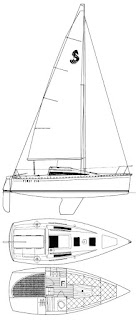
There's a Beneteau 235 for sale here that caught my attention and got me thinking about what a great little cruising boat it would make.

Now as far as French production boats go, I've never been a huge fan of the Beneteau boats preferring the Jeanneau designs back in the pre-conglomerate days. I expect that's mainly because of the designs of Philippe Harlé like the Sangria, Fantasia, and Tonic.

As far as the Beneteau 235 is concerned it fills the same design niche as the Tonic.

Now, I don't know about you, but the idea of a Tonic or a Bendy 235 as a cruising boat makes a whole lot of sense and inspires dreams of unfettered freedom.

Sure, they're small but small equals a low price, minimal cruising expenses, and small problems. 

That said a small boat is not for everyone.

Back when I was considering buying a Tonic for serious cruising my life was pared down to just the essentials and that's a given where cruising in a small boat is concerned.

These days, where anything smaller than a forty-foot boat is considered small, what is considered essential is a very different thing and people do love having a lot of stuff.

For me. the real beauty of a small design like the 235 is that there is simply no room for anything that is surplus to requirements. The idea of not having to contend with dragging stuff you don't need or use actually qualifies as something akin to a luxury.

Which is not to say it would be an easy transition for most. I'm in the middle of a never-ending struggle  to cull all the various stuff that seems to accumulate and just takes up room but never gets used. So I'm well aware how difficult it can be.

The attraction of a little boat like the 235 or Tonic, for me at least, has everything to do with jettisoning all the stuff I don't need and getting back to a simpler and more focused life. Which, when you think about t is why most of us decided to sail away in the first place.

I often do a mental exercise where I work out how I'd cruise a given boat where I use an Atlantic circle as an example. While doing an Atlantic circle on a 235 is not on everyone's with list it would be an excellent way to sort out just what you'd actually need after you've done your Wordle for the day.

Now, If only I can bring myself to throw away that bent stanchion I can't find a use for...


Monday, July 5, 2021

regarding a very long voyage in a pretty small boat...

I read recently how Keith Leitzke has returned from another cruise to nowhere in particular and it got me thinking about a few things...

The first being how that Bill Lapworth's CAL 20 is still a great minimal cruising design in spite of the fact that it was never really designed to be one.

While I'm sure the Cal 20 would not be everyone's choice for a long sea voyage apparently Keith Leitzke thought it was just the thing for a four month or longer blue water voyage.

The fact that the Cal  20 has more than proven its blue water bona-fides with numerous trans-pacific voyages to its credit just goes to show that seaworthiness is not dependent on cost or size.

Of course, doing extreme blue water voyages in small boats means that one has to get creative to the Nth degree where space and loading is concerned. Seriously, just how do you store four months or more of provisions, water, and other needful gear?

Just thinking about how to store 120 gallons of water on a Cal 20, for starters, kinda makes my brain hurt! Throw in the provisions of even the most stoic menu for four+ months and you're talking about some genius creative use of space...

Well that or getting into TARDIS territory.

The important thing to keep in mind is that, obviously, it's been done so it's possible and knowing something is possible means all you have to do is figure it out because impossible is no longer an option.

Just sayin'

Support BoatBits

Monday, May 17, 2021

An interview with Sailing Blowin' in the Wind...

I've gotten to the point that when someone writes me and says to check out a new YouTube channel I pretty much prepare for the worst. So, when a friend dropped me a line a while back and said I should really check out "Sailing Blowin' in the Wind" I wasn't exactly filled with enthusiasm. Face it, most of what passes for Sailing & Cruising content more than proves that Sturgeon's Law was actually overly optimistic.

Armed with the fact that I could always just turn off the computer if things became too dire, I followed the link and watched the first episode fully expecting it to be just another "Look at us we're wonderful" selfie-fest.

Nope, it was different. It was actually interesting and far from being the same old same. Better yet, I actually enjoyed it. OK, I'll admit to being a hard audience where film and video is concerned especially where sailing, boat building, and cruising content are concerned, but the main thing is that Sailing Blowin' in the Wind actually caught my interest and eighteen episode later I'm still watching. Need I say more?

I won't go into what actually transpires on the Sailing Blowin' in the Wind channel because you'll do better watching it it from the start. So I'll just say that Anna Key and Tom Break live on a 28-foot sailboat without an engine with their two boys, Roo and Zibby, and their two girls, Mia and Xani.

Obviously not the same old same cruising story. 


Now let's get to the interview...

Why not get to the important stuff first and deal with the elephant in the room. So, just how many ukuleles or musical instruments do you have aboard Blowin' in the Wind?


We've been caught red-handed—we’re already going to start sounding like very bad minimalists! Until this summer we had four soprano ukuleles, one each for the three older kids and one for Anna. Since then, we've been gifted a concert ukulele and a "guitalele," which is a six-stringed instrument rather like a very small guitar. We also bought some bongo drums, and Anna has hopes of acquiring a small steel-tongue drum and a baritone ukulele down the road, maybe after some of the kids are grown and take some of their instruments with them. (;  It's getting a little out of control here, but the music has become a bigger part of our life than we expected, especially since it has become such a vital part of our video-making.


Six people on a 28-foot boat?


It's a lot of people in a small space, but in our defense there were berths for six adults when we moved aboard. When we got started looking for boats, we listened to what people around us were saying and kept our eyes out for something in that 35-40' range, but we quickly realized that those larger boats rarely had more beds: there was just more space (a bigger galley or nav station) and a bigger price tag. We ultimately decided that the extra amenities weren't worth the extra cost (costs that would keep adding dollars per foot every time we pulled onto a dock, got the bottom cleaned, etc.)


As we circled back around to what we really cared about—nimbleness and ability to be single-handed, affordability, and sturdiness—it became very clear that we would do much better with a smaller boat than a bigger one. And even if it meant being close together, we could actually be together instead of leaning on a full-time job for years to pay off the boat. When we stepped onto Blowin' in the Wind, we thought she was a 30, not a 28—the designer made great use of every foot, and we fell in love with her right away.


I get that. Having built and cruised various boats which don't pass the "group think" of what a cruising boat is supposed to be, the whole "You're going to cruise in that?" gets old real fast. Obviously you're not just doing a different boat, you're also doing things differently to make Blowin' in the Wind more livable and cruise-worthy. How is that going?


Some things are going great and some things are a struggle. The interior space that we opened up when we took out the engine is fantastic. It's created a great flow of space and the kids have lots of places that they can hide and play and make messes and create elaborate battles or creations with the few toys we have on board. And since we closed up all of the thru-hulls, Anna has been able to sleep through the night without ever waking up with dreams that the boat is sinking. We don't really miss fancy things like the water heater, electric water pumps, or the other gadgets that we've gotten rid of because those are just things that we  don't have to be stressed anymore about not knowing how to fix.


Most of the changes we've made have caused very little extra hassle. It's taken some time to get used to the rhythm of managing the composting head and of taking the sink buckets out to dump them instead of using the standard pump-out system and draining water through the thru-hulls, but we don't mind that work and have adapted to it really well. And the daily maintenance work replaces the big repairs in which you're knee deep in leaky head hoses, which it's easy to overlook when things are working. In general, every time we take out a system and replace it with a simpler version, life gets a little bit harder but a little bit better. Those little additions of time do add up, and when we press toward some of our more extreme goals, like producing no trash, things can get overwhelming. But for the most part things are going remarkably well. We're becoming increasingly comfortable in our increasingly unique boat.


How's the yuloh working out?


The yuloh, and lack of engine generally, has been one of the biggest challenges. On our shakedown journey everything was going swimmingly until we got caught in a surprising current, lost sail power, and couldn't get the yuloh out fast enough to get around a tight corner. That shook us somewhat, and has led us to re-think some things. My home-made yuloh is very heavy, so we're going to try a smaller sculling oar that's easier to deploy but that can still push us, and we're going to trade out the wheel for a tiller so that there's less congestion in the aft area of the cockpit, and we'll see where we are at that point. Lots of people are telling us that we should attach an outboard or at least have one for the dinghy to tow us through tight spots. We're considering that option going forward, though I really would prefer to keep things as simple as possible so that I don't have something (that I can't fix) break at just the moment I'm counting on it.


Nothing improves one's sailing skills more than simply not having an engine. Do you have a drifter?


That's right. And I would add that nothing improves your awareness of your environment, either. When you're relying on an engine, it's really easy to be blissfully unaware of what the tides and currents are doing, and what the weather might do should you get delayed, and while it ends up being no problem for most people most of the time, I'm glad for the need to be aware. It's making me a better sailor already—though I'm starting from being a total novice, so that's not saying much. No, we don't have a drifter, but our boat does very well under our 150% genoa, even in very light winds.


That said, in the meantime, you might want to consider kedging as another needful tool in your engineless quiver.


Kedging was ultimately how we got off the dock we got caught on during our shakedown, and it's a really critical tool for us. We keep a light "lunch anchor" on hand in the cockpit as a brake and I've got a second heavy anchor there as well so that they're ready to hand if we need them.


You've mentioned the Pardeys but do you have any other influences in your quest for a simpler nautical lifestyle? Annie Hill, Jerome Fitzgerald for instance?


We hadn’t heard of Annie Hill or Jerome Fitzgerald, but thanks for the tip! As for other influences, we're big idea people, and so a lot of what we bring to sailing comes from thinkers of the past, folks like Diogenes, Simone Weil, St. Francis of Assisi. One really critical nautical influence is a family that calls themselves the Coconuts, who have been sailing an engineless sailboat with four kids for years now. Drake Paragon made a lovely 5-part documentary about them, and they've been a great encouragement to us largely because they've show that sailing with a family and without an engine is possible. We figure that if they can make it across the Atlantic, we should be able to make it to the Caribbean.


Another practical influence for us is Helen and Scott Nearing, authors of The Good Life, who bought a farm and committed themselves to working only half days half of the year supporting themselves so that they would have time to read, think and write. We really respect the way that they were able to make that a priority and stick to it. A big reason we sought out this life, and that we try to keep it simple, is to carve out time in our days for artistic work and for contemplation (both for us and for our kids). I don't think that we can underestimate the damage that lack of that kind of time is doing to our society, generally, and so it's a priority for us and something we want to protect for our whole family.


How would you define your current cruising plans?


Equivocally. Tom's just back from a trip to the Bahamas where he got some open water experience and some sailing time in around the islands, and we're all really excited to get moving in some direction, but we're not exactly sure what direction that's going to be at the moment. Hurricane season is creeping up on us, and while we have some desire to make tracks for the Luperon in the Dominican Republic before the worst of hurricane season hits, that's seeming like a long journey on a short timeframe right now. So we'll either make the leap, hide out in Florida somewhere, or head north until next season.


Beyond the short term we really want to sail the Caribbean. We want to spend good chunks of time in both Spanish and French speaking countries to get language intensives for the whole family. It's kind of amazing just how much of world history winds its way through those islands—how many cultures have met, clashed, and melded in wildly different ways from island to island, so we're excited to explore the islands and learn from them about different ways to live. Anna especially has desires to visit Chile and the boys want to surf in Hawaii, and I would love to hike the Camino de Santiago in Europe. Those points on the map seem really far away right now, but who knows what the future will bring.


Do you have a target budget?


Our target is the federal poverty level for our family, which in 2020 was $35,610, or just about $3000 a month. That's pretty attainable for us while underway, in general. It's actually pretty important to us to be able to live at the poverty line. We want to use as few resources as possible, and not spending money is the easiest way to do that. Beyond that, though, the poverty line ought to be an attainable goal for everyone, and I think we would feel bad living a lifestyle that isn't, at least in principle, open to everyone.


The target is of course a target, and we've had varying degrees of success hitting it. Some of the things that have gotten in the way are boat-related things: boat work is expensive and can crash a budget pretty quickly. Tom worked a full-time job for a couple of years that increased our income and allowed us to do work on the boat that would have been a stretch on the poverty-line budget.  


Since then, Tom left the full-time job and we continue to work the budget from both ends: trying to reduce our spending to get it under the poverty line, and to increase our income to get it over the poverty line. We're getting closer, but we're not yet "in the black," and therefore continue to switch between travel and focus on our artistic work and periods when we do work to re-fill the "cruising kitty."


Any ideas or cunning plans you're currently working on?


Well, we’re artists, so we’re full of ideas. We both really love an aphorism by the philosopher Friedrich Nietzsche, “What good is a book that doesn’t lead you beyond all books?” So we’re trying to make a YouTube channel that leads us beyond all YouTube channels, that might even lead us…outside. It’s our most cunning plan yet. We are, however, still in need of a cunning plan to get out of the next inlet…




Wednesday, April 14, 2021

On that big hole in the water you throw money into...

OK, I get it. "Everyone" says that if you buy a fixer-upper sailboat with the goal of turning it into a cruising boat it will all end in tears. Some will tell you that you'll wind up with nothing but an expensive disaster that you'll have to pay someone to dispose of it in some landfill.

I could go on but I expect you've already heard it all before and it's boring...

What I will do is point out that the disaster or failure scenarios of this sort have a lot to do with people who have made stupid mistakes in choosing their projects, have little in the way of an intelligent plan for the needful work involved in the enterprise, and a poor skill set where boat building and repair are concerned. Which is another way of saying that if the boat refit project failed it's because the person doing it screwed up big time.

Every once in awhile I'll point out what I think is a possible project boat like the Ericson 26 so we'll use that as our crash test dummy. Which brings us to the question of whether or not an Ericson 26 is a good choice as a cruising boat for you?

So, you'll need to put away the rose colored glasses to do some research and a bit of math. Seriously if you don't properly research the project and work out the costs you're in clusterfuck territory. For starters you really need to research the market for the Ericson 26. 

  • What does an Ericson 26 in great shape cost?
  • What does an OK Ericson 26 cost?
  • Does the Ericson 26 have an inbuilt issues which will need to be repaired and cost you money (FYI ALL production boats have some issue(s) or other that will need attention so find out what it is)?
  • Can you afford an Ericson 26?

With me so far? Most boat projects fail simply because someone did not ask and get real answers to those four simple questions. Let's say you've answered the previous questions, got your answers and think it's time to move to the next level which requires a few more questions.

  • Is the Ericson 26 a boat that I'll be able to cruise comfortably on without major changes?
  • Do I have access to an affordable location in close proximity to work on the boat?
  • Am I willing to put some effort into learning the needful skills to refit the boat?

Some of you may have noticed that none of these questions involve the actual fixer upper in question. My advice is to always do your homework before not after viewing a possible project as the more you know about the boat the better your advantage you'll have when you actually look at it. 

In fact I'd recommend, before you go boat project shopping, that you build a dinghy as a proof of concept that your abilities are up to the task. My advice for most folks is to build the Bolger Nymph from Dynamite Payson's "Build the New Instant Boats" As it's a great dinghy, does not take a lot of outlay in materials, and pretty much shows you if you have the needful skills and mindset or not to take on a much bigger project like the Ericson. No pressure but if it takes you more than 24-hours of labor to build a Nymph rowing version you might want to forget the idea of anything larger than a dinghy refit projects.

Just saying.

We'll get into how we handle looking at a fixer-upper in the next bit...


Saturday, November 14, 2020

A new YouTube channel you might want to check out...

A family of six on an engineless Ericson 28.

 Most certainly a channel I'll be following.

Wednesday, January 15, 2020

Ranger 26: Breaking down the problems and needful things..

Some interior musings.

When looking at the Ranger 26 a few things cry out for attention.  Most notably the galley, or should we say the lack of a galley, situation. Everybody needs to eat and anyone living on a frugal cruising budget is going to be cooking most all of their meals aboard so it is a very important system on any VolksCruiser. We're going to have to shoehorn a reasonable galley workplace where you can actually cook as opposed to just heating stuff up. Throw in the fact that you'll need easily accessible stowage for galley utensils and a means of easily washing up after cooking/dining which entails water storage and and plumbing. This area might actually be the most difficult project on the list.

Next on the list is the head. I've lived with a portapotti and you can get by with one but as a DIY composting toilet takes about the same amount of room, is actually cheaper than a portapotti or MSD, and works better so the composting toilet gets on the project list. Having a proper bathroom on a 26 foot boat is really just too problematic so we'll work along the lines that showers will be in the cockpit and work on that issue when we're working on the cockpit.

A comfortable dedicated place to sleep is important. The Ranger 26 has a dinette which can be converted into a double bed, a V berth forward and a settee which opens to a wider single if you remove the back board. My guess is the V berth makes the best choice for most folk but it is something you may want to give some serious thought to.

A place to lounge. Everybody needs a comfortable place to sit and read, watch videos, or just relax. Comfort is important and it is vital to keep this in mind while you're making decisions. For most people the settee will fill this need. Personally, I'd vote for the settee because you'll also need a workable sea berth and it can do double duty.

Stowage, of course, the boat needs more stowage, fact is all boats need more stowage. You need a place for food, water, fuel, clothes, tools, books, toys and the list tends to be endless.There are a lot of clever (dare I say cunning?) ways to maximize stowage but the real trick is to realize that a 26-foot boat is a finite space and you're going to have to do some serious need/want exercise to get that endless list down to a manageable one that will fit into a 26-foot long envelope. Your ongoing mantra will have to become...

"Less stuff more stowage!"

Which leaves us with the project list for the interior so far as:
  1. A new galley
  2. A composting head
  3. Adding more stowage
Next up we'll look at what we need to think about on the deck, cockpit, and add a wild card to the mix.

Tuesday, January 17, 2017

a couple of links...

Yachting Monthly has a nice article online about a single handed trans-Atlantic voyage aboard a a 27-foot Sadler that is well worth the read...

Meanwhile, over on the HEO forum there's an interesting thread about a crew of three crossing the Atlantic in a 25-foot Sangria.

Under 30-feet works.